Wireless Setup

The Wireless Setup options in your modem settings allows you to control your wireless network.

Videos: Wireless settings

Access Wireless Setup

Note:  Your modem settings may appear slightly different from the images below, but the steps will be the same.
Wireless Setup menu options

Select a wireless setup option from the menu. 

Click on the menu options below to see a screenshot and brief description.

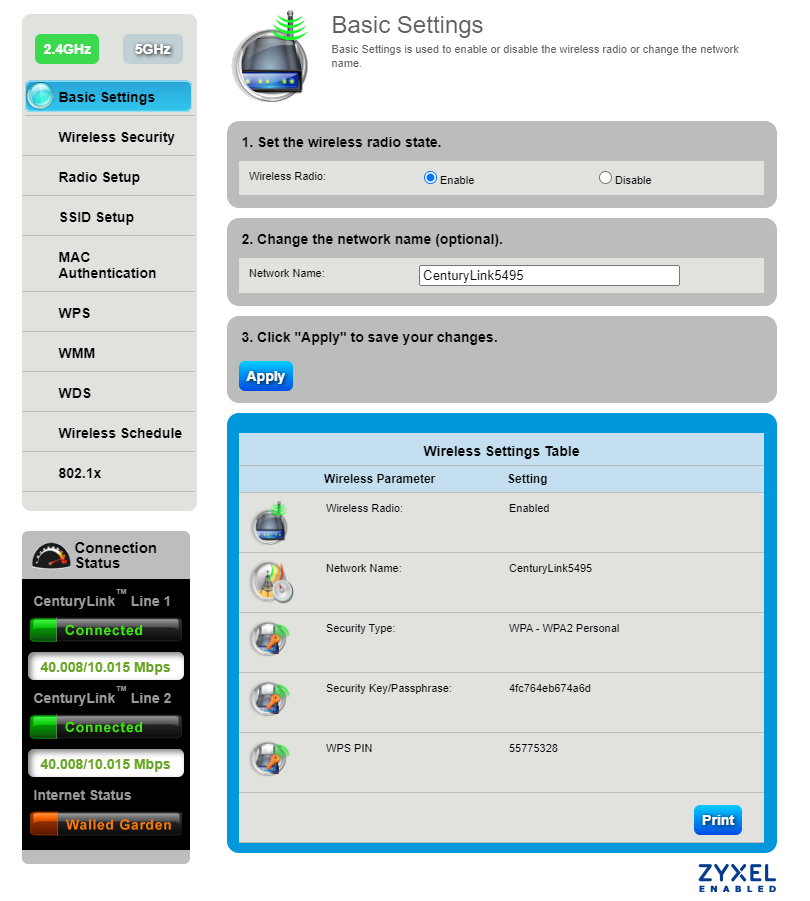
Enable/disable the wireless radio, change the network name (SSID), view the current security type, key/passphrase, and WPS PIN for the modem.

5.  If given the choice, select 2.4 GHz or 5 GHz in the left sidebar. Some models do not offer this option. Read more about the how to choose between 2.4 and 5 GHz frequency, and learn which modems have this capability.

6.  Select Enable for the Wireless Radio. You can also change the network name (SSID) to something more personal and easier to remember here. Finally, you can view more details about your wireless connection, including the security type, key/passphrase, and WPS PIN.

Basic Wireless Setup Step 6

7.  Select Apply to save changes.

Basic Wireless Setup Step 7

8.  Next, make sure the modem is broadcasting the network. To do this, select SSID Setup.

Basic Wireless Setup Step 8

9.  Select the network name (SSID), which you can find printed on the sticker on the bottom of your modem.

Basic Wireless Setup Step 9

10.  Select Broadcast SSID.

Basic Wireless Setup Step 10

11.  Select Apply to save your changes.

Basic Wireless Setup Step 11

The wireless light on your modem will turn green when the WiFi network is enabled. Once it's on, you can connect devices to your wireless network. Be sure to connect devices using the same frequency you selected on your modem (2.4 GHz or 5 GHz).

Wireless Security:  Change the network name (SSID), password, and security type (WEP/WPA/WPA2) for your network.

The Radio Setup allows you to set the wireless channel, power level, 802.11 mode, spatial streams, aggregation, and MIMO power save.

The wireless channel is auto-selected by your modem. Channel settings should not be changed unless instructed by your ISP. 

5.  Select 2.4 or 5 GHz in the left sidebar. 

6.  Select Radio Setup.

7.  Select a channel, from 1 to 11.

8.  Select the desired wireless channel width

9.  Select a wireless power level. This will be from 25% to 100% for 5 GHz. The optimal power level depends on your environment.

Selecting an optimal channel power level

  • Lower power settings create a circular coverage area with better coverage near the modem but a shorter signal range.

  • Higher power settings create an elliptical coverage area with a longer range but with reduced coverage closer to the modem.

10.  Select a 802.11 mode. 

You can configure your network (SSID) and manage up to four wireless networks.  

5.  If given the choice, select 2.4 GHz or 5 GHz in the left sidebar. Some models do not offer this option. Read more about the how to choose between 2.4 and 5 GHz frequency, and learn which modems have this capability.

6.  Select SSID Setup from the menu on the left sidebar.

7.  Select the name of your wireless network (SSID). It's usually the one at the top of the drop-down list.

8.  Select Enable SSID to activate the network, or Disable SSID to deactivate it.

Note: On some models, you will also have the choice to "Broadcast" the network, meaning it's visible to anyone in range, or "Hide" it from public view.

9.  Enter a custom network name if you want (optional). This can make it easier to find your network when connecting devices to WiFi.

MAC authentication allows you to limit who can and can't connect to your WiFi network by allowing or denying devices by their media access control (MAC) address.

5.  If given the choice, select 2.4 GHz or 5 GHz in the left sidebar. Some models do not offer this option. Read more about the how to choose between 2.4 and 5 GHz frequency, and learn which modems have this capability.

6.  Select MAC Authentication in the menu on the left.

7.  Select your wireless network (SSID). Your active network will usually be the one at the top of the drop-down list.

8.  If you are setting up MAC authentication, select Enable.

9.  Set the list type to Allow or Deny. This determines whether the MAC addresses you enter in the next step will be allowed to access your network or forbidden.

10.  Enter the MAC address (or select a device from the drop-down) that you want to allow deny, depending on the "list type" set in step 9.

WiFi Protected Setup (WPS) provides an easy and secure way to establish a wireless network by sharing the wireless key between your modem and devices. 

5.  If given the choice, select 2.4 GHz or 5 GHz in the left sidebar. Some models do not offer this option. Read more about the how to choose between 2.4 and 5 GHz frequency, and learn which modems have this capability.

6.  Select WPS in the menu on the left. 

7.  Here you can disable WPS, select the WPS type, and initiate a device to connect to your network. You can also initiate a connection by pressing the WPS button on your modem or within the device settings.

WiFi multimedia (WMM) is a quality of service feature that prioritizes traffic on modem's 2.4 GHz wireless network.

5. Select 2.4 GHz in the left sidebar.

6.  Select WMM in the menu on the left sidebar. From here you can enable or disable WMM and the WMM power save mode.

The wireless distribution system (WDS) allows the connection of access points through a wireless connection on your 2.4 GHz WiFi network. 

5.  Select 2.4 GHz in the left sidebar.

6.  Select WDS in the menu on the left sidebar. 

Set days and times that your WiFi network turns off automatically. The wireless light on your modem will turn amber when the wireless (radio) signal is disabled. 

5.  If given the choice, select 2.4 GHz or 5 GHz in the left sidebar. Some models do not offer this option. Read more about the how to choose between 2.4 and 5 GHz frequency, and learn which modems have this capability.

6.  Select Wireless Schedule in the menu on the left side. 

7.  From here you can select Enable to turn on scheduling mode. Then set the days and times that you want your WiFi network to be disabled. When you're done adjusting the schedule, select Apply to save your changes.

The 802.1x settings allows you to combine wireless security methods with the benefits of a radius server. This setting applies to 2.4 GHz frequency wireless networks only.

5. Select 2.4 GHz in the left sidebar.

6.  Select 802.1x in the menu on the left sidebar. From here you can view and edit the settings for your WiFi network (SSID).

Always select Apply to save your changes to any of the settings.

Top Tools