What's a GUI, you ask? It sounds like "gooey" and stands for "graphical user interface." It's just a fancy tech term for the secure website where you go to manage your modem settings. Learn more about what you can do in the modem GUI and how to use it.
What can you do in the modem GUI?
If you have a CenturyLink "modem," it's actually much more than a modem. It controls your whole WiFi network and functions as a router. The modem GUI is where you go to do the following, and much more. See the section at the bottom of this page for a complete list of options.
GUI Area
Most Used Options
Status
Check status of DSL, Ethernet, and WiFi connections
See WiFi channel and signal strength
WiFi
Create a 2nd network
Change security type
Update network name or password
Utilities
Reboot or reset your modem
Back up and restore settings
Update firmware
Advanced *
Initial setup of your network connection
Change admin name or password
Control IP settings
Manage access controls and blocking (for users without Secure WiFi)
* Some advanced options are best for advanced users who have some experience with IT or networking.
How to sign in to the secure modem settings
Follow the steps below to open and sign in to the secure site.
Important notes:
You must be connected to your home network to access this web page; if you try to open the link from another location, it will not load.
Note that the URL starts with http (not https); for this reason, many browsers will flag it as a security risk. Rest assured, it's safe!
1. Connect a device to your network over WiFi or using an Ethernet cable connected to your modem. This works best on a tablet or computer.
2. Open a web browser and type http://192.168.0.1 into the web address field.
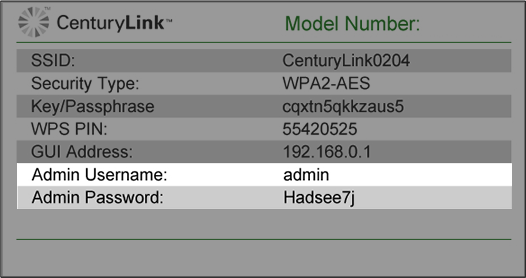
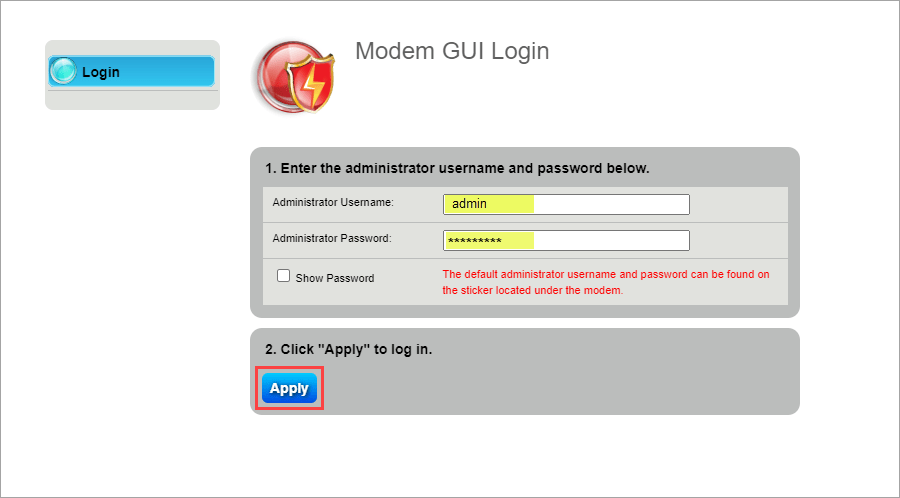
3. Sign in to the modem settings (GUI) using your Admin Username and Admin Password, printed on the sticker.
You can find the Admin Username and Password printed on the sticker attached to the side, back or bottom of the modem.
CAUTION!Do not remove your modem sticker. It includes your default Admin Username and Admin Password, which cannot be retrieved if lost. Your modem could become unusable without them.
Overview of the modem settings menu
Once you sign in, you see a main menu with five options. Open the sections below to see settings available in each area. Features vary slightly by modem, so the options listed here may not be available on all modem types.
The modem status area shows several options to check on your network connections, devices, and functions.
Quick Setup provides a quick and easy place to enter setup credentials, if needed, when first installing and activating your modem. The PPP username and password are needed to connect to the CenturyLink network and get internet access. In many cases, these are preset before you receive your modem. If you are resetting a modem or need to reenter these for any reason, you can chat with our support agents for assistance.
Your modem's wireless settings control the WiFi network in your home. Many of our modems have 2.4 GHz and 5 GHz options that you can control separately.
Advanced settings give you even more control over your modem setup, including blocking, IP addressing, and security options. Most of these settings are best for tech-savvy folks; altering these settings without the right knowledge can lead to equipment failure.